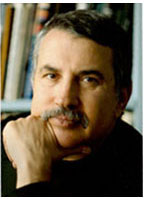
In the past, America has been the leader of the world in innovations, science, business and many other fields. We were considered the land of opportunity, where people came to make a new start. Currently though, we are falling well behind Europe and many other nations due to our inability to accept the fact that we need to change. We are building walls around ourselves, hurting our image. We are embracing stupidity, and forgetting the value of knowledge. And we are closing our minds to the prospect of change. In Thomas Friedman's book Hot, Flat, and Crowded, the problems with America today are explored along with ways that we may pull ourselves back onto our crumbling throne.
After 9/11, America took a defensive stance against the rest of the world. No longer is America the land of opportunity, where we welcome immigrants with open arms and minds. Our security now restricts many from even entering the country, and as a result, the way the rest of the world views us has fallen drastically. As Friedman points out
"An America living in a defensive crouch cannot fully tap the vast rivers of
idealism, innovation, volunteerism and philanthropy that still flow through our
nation" (5).
It has turned into a vicious cycle, kids in foreign countries see America as where they want to be, and how they want to live. When they are denied the luxuries we enjoy, they understandably hate us, and consequentially tend to join group like the Taliban. Right now we are spending billions on war and defense. If we were to put more money into starting American style schools in foreign countries, and welcoming anybody who wants to try the American lifestyle, we would begin to end problems like terrorist groups, intent on our destruction. This idea of spreading knowledge, not war, is pretty liberal, and many would oppose it, but seeing as the war method has not really gotten us anywhere near world peace, maybe we should try a new tactic.
Another disturbing trend that is affecting America is the notion that we can be
"as dumb as we want to be"
This frightening aspect of our current culture puts little emphasis on solving important problems, like ones having to do with the health of our population, and our environment. instead, we indulge ourselves in bickering about red state, blue state aspects of our political scenery. The easy solution to this is a simple wake up call. We need to wake up and smell the CO2 buildup in our atmosphere. Then we need to put more money into saving things vital to the survival of our species, like our planet, rather than investing in petty political campaigns. If we destroy the planet and don't survive, it will not matter what political party you are with. Some will contest that all great nations come to an end, but it is the hope that we have been able to evolve since then, and to learn where others made mistakes. Should we go on ignoring the signs, we may cause history to repeat itself, with dire consequences.
At the moment, we are far behind other countries in our ability to sustain ourselves with energy not from foreign nations.
"France Gets 78% of its electricity from nuclear plants and much of waste is
reprocessed and turned into energy again"(14).
We are almost completely dependent on foreign oil. While other countries have very high gas prices, and high mileage requirements, we continue to not raise our standards for cars, allowing car companies to continue to produce Hummers and SUV's, facilitating the need to import oil. The defense is that raising taxes would upset the economy. We have proof that it will not (if instituted correctly) after the Danish government raised gas prices, and imposed a CO2 tax, their economy
“has grown 70 percent while our energy consumption has been kept almost flat”
(18).
Europe and Japan, with their high gas prices and taxes on engine size now are making smaller and smaller cars, which are much better for the environment. The good news is that in 2007, Congress moved the fuel economy standard up to 35 miles per gallon, by 2020. Sadly, this is where Europe and Japan are already. If we were to take action quicker, with more drastic measures, we might be able to catch up. But our leaders are more concerned with upsetting the economy than saving the planet. In this area, we have already lost our title of world leader.
As a country, we have been great. That is undeniable. We have created an image for ourselves that now, we cannot uphold. Our values of equal opportunity, innovation and change for the better have all but been forgotten in recent years and we have suffered accordingly. We no longer are considered the first, the leading country. If we wish to crawl back to our spot on top, some serious changes will have to be made quickly. The means for improvement are there, we just need to take advantage of them. But the one thing we have to watch out for is time, the number one non-renewable resource.